


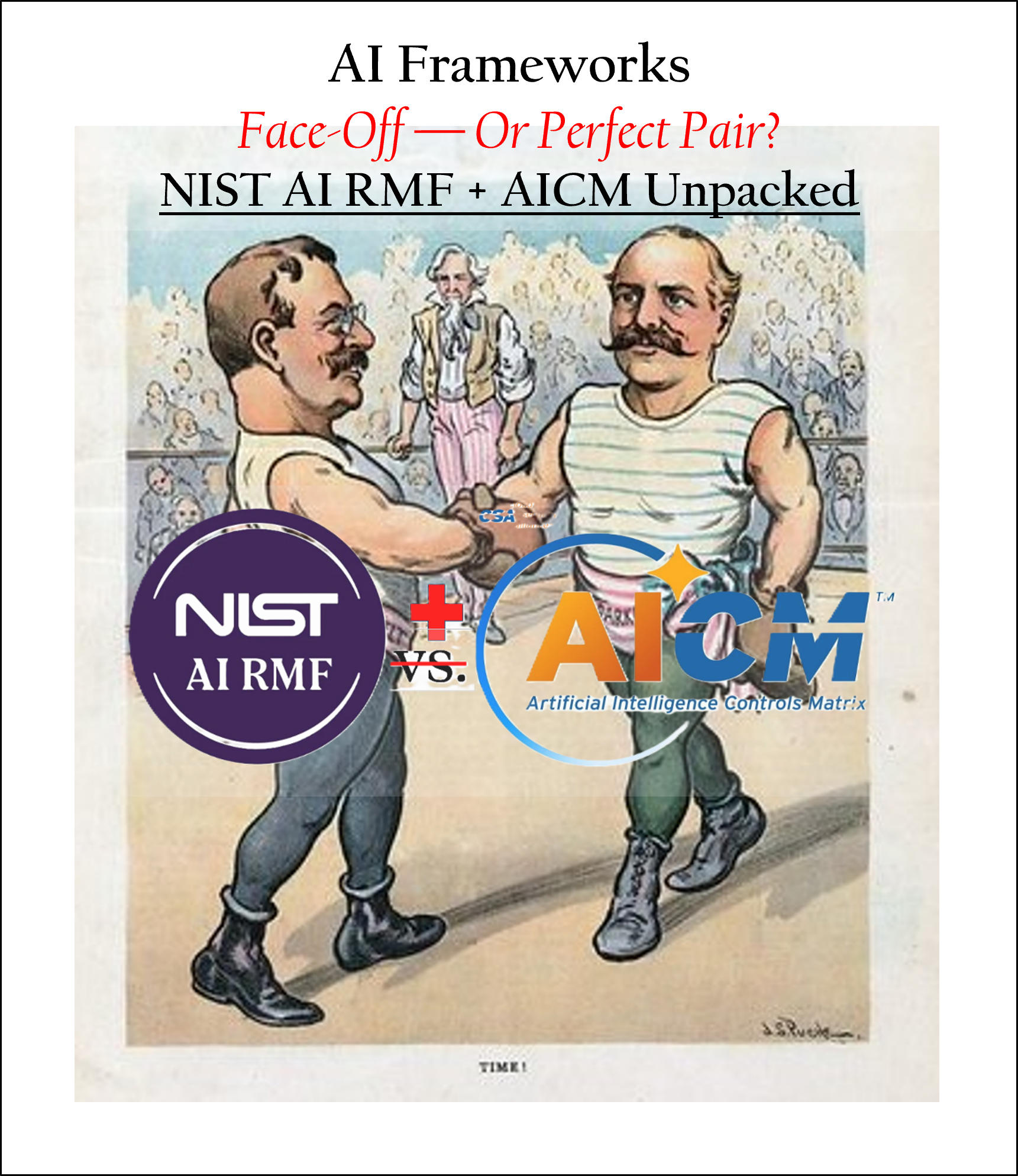
AI Frameworks: Face-Off—Or Perfect Pair?
NIST AI Risk Management Framework +
CSA AI Controls Matrix Unpacked
Summary Table of Contents
- The Big Question – Competing frameworks or complementary tools?
- At a Glance – NIST AI RMF: strategic guidance; AICM: tactical controls.
- Key Differences – Purpose, structure, depth, and focus areas.
- When to Choose Each – High-level guidance (NIST) vs. audit-ready controls (AICM).
- Better Together: The Power Duo – Strategy + implementation = end-to-end AI governance.
- Trade-Offs to Consider – Pros and cons of using one vs. both.
- Recommended Approach – Start with NIST, layer in AICM as needed.
- Bottom Line – Not “vs.”; Using both delivers comprehensive AI governance.
1. The Big Question
The AI Controls Matrix (AICM), developed by the Cloud Security Alliance (CSA) and released in July 2025, and the NIST AI Risk Management Framework (AI RMF 1.0), released by the U.S. National Institute of Standards and Technology in January 2023, are both voluntary frameworks designed to promote trustworthy and responsible AI. While they share similar goals, they differ significantly in purpose, structure, depth, and application.
So the real question isn’t just “Which is better?”—it’s whether these frameworks are competing choices or complementary tools.
2. At a Glance
Purpose and Scope
- NIST AI RMF: A high-level risk management framework focused on identifying, analyzing, and mitigating AI risks to individuals, organizations, and society. It emphasizes building “trustworthy AI” through considerations like validity, reliability, safety, security, accountability, transparency, explainability, privacy, and fairness. It is sector-agnostic, flexible, and designed for broad use across the AI lifecycle (from design to deployment and beyond).
- AICM: A detailed control framework (often described as a “controls matrix”) specifically for implementing secure and responsible AI, with a strong emphasis on cloud-based and generative AI/LLM systems. It builds directly on CSA’s established Cloud Controls Matrix (CCM) and translates high-level risks and principles into actionable, auditable security and governance controls. It covers the full AI supply chain and lifecycle, with a focus on operational security, compliance, and assurance.
Structure and Format
- NIST AI RMF: Organized around four core functions — Govern (culture and oversight), Map (contextualizing risks), Measure (assessing and tracking risks), and Manage (prioritizing and responding to risks). These functions contain categories and subcategories with suggested actions and outcomes. It includes a companion Playbook for implementation guidance but remains principle- and outcome-oriented rather than prescriptive.
- AICM: A spreadsheet-style matrix with 243 control objectives distributed across 18 security domains (e.g., Model Security, Data Security and Privacy, Governance/Risk/Compliance, Application and Interface Security, Supply Chain Transparency). It is analyzed through five pillars: Control Type, Applicability and Ownership, Architectural Relevance, LLM Lifecycle Relevance, and Threat Category. This makes it highly granular and multi-dimensional.
3. Key Differences
Level of Prescriptiveness and Usability
- NIST AI RMF: High-level and flexible. It provides guidance on what to consider and why, allowing organizations to adapt it to their context. It is not a checklist of specific controls but a structured process for ongoing risk management. Many organizations use it as a foundation or overlay for their AI programs.
- AICM: Highly prescriptive and operational. It offers concrete control objectives (similar to SOC 2 or ISO 27001 controls) that organizations can implement, assess, audit, or use in procurement/contracts. It includes self-assessment questions and is designed for measurability and assurance, making it more “audit-ready” and suitable for demonstrating compliance.
Focus Areas
- NIST AI RMF: Broad trustworthiness characteristics, including societal/ethical risks, bias, and human-AI interaction. It addresses risks holistically but at a conceptual level.
- AICM: Strong emphasis on security-specific and technical controls for AI (e.g., model manipulation, data poisoning, supply chain threats, LLM-specific risks) alongside governance. It explicitly addresses cloud/AI architectural layers and integrates traditional security practices into AI contexts. It also maps directly to regulations and standards like the EU AI Act, ISO/IEC 42001, ISO 27001, and NIST AI RMF itself.
Relationship and Complementarity
The two frameworks are complementary rather than competing. AICM explicitly maps its controls to the NIST AI RMF (among others), allowing organizations to use the RMF for overarching risk strategy and the AICM for detailed implementation and verification of controls. AICM is often positioned as a practical “how-to” extension that operationalizes principles from frameworks like NIST AI RMF or ISO 42001.
Other Practical Differences
- Audience/Applicability: NIST AI RMF suits a wide range of organizations (including non-cloud or non-GenAI users) for strategic risk management. AICM is particularly valuable for cloud service providers, AI developers/deployers, and enterprises seeking auditable security controls in GenAI/cloud environments.
- Origin and Style: NIST (government-led, consensus-driven U.S. standard) vs. CSA (industry/non-profit, practitioner-driven, building on cloud security expertise).
- Release and Maturity: NIST AI RMF is more established (2023) with supporting resources like crosswalks. AICM is newer (2025) but rapidly gaining traction for its control granularity.
4. When to Choose Each
If Selecting a Single AI Framework
Choose NIST AI RMF if you want:
- A high-level strategic guide to manage AI risks overall.
- Flexibility to fit any organization, any AI use case (not just cloud or generative AI), and any size.
- Focus on the big picture: understanding context, measuring risks, making decisions, and building trustworthy AI (fairness, transparency, safety, etc.).
- Something easy to start with—no strict checklist, just a repeatable process (Govern → Map → Measure → Manage).
It’s ideal for getting started, setting policy, or aligning with broader risk management. Many organizations use it as their foundation because it’s voluntary, adaptable, and government backed.
Choose AICM (AI Controls Matrix) if you want:
- Concrete, actionable controls you can actually implement, measure, and audit (243 specific control objectives across 18 domains like Model Security, Data Privacy, Supply Chain, etc.).
- Strong emphasis on security and operational details, especially for cloud-based or generative/LLM AI systems.
- Help with vendor assessments, contracts, self-audits (via the AI-CAIQ questionnaire), or showing compliance.
- Ready-made mappings to other standards (including NIST AI RMF itself, ISO 42001, EU AI Act, etc.) so you can prove you’re meeting multiple requirements at once.
It’s ideal when you need the “how” — practical steps, shared responsibility models (who does what in the AI supply chain), and audit-ready evidence. It’s particularly useful for cloud-heavy environments or enterprises already using CSA’s Cloud Controls Matrix.
Key Takeaways:
- NIST AI RMF = “What should we think about and why?” (Strategic & flexible)
- AICM = “What exactly do we need to do?” (Tactical & prescriptive)
5. Better Together: The Power Duo
The Best of Both Worlds: Using the frameworks together
Use NIST AI RMF for the overall risk strategy and governance, and CSA AICM to fill in the specific security controls and make everything auditable. They’re complementary, not rivals.
If your needs are more about broad risk management → start with NIST.
If you’re focused on implementation, cloud AI security, or vendor assurance → go with (or add) AICM.
Why Use Both? (The Simple Reasoning)
- NIST AI RMF gives you the “What and Why” — a strategic, flexible process for identifying, assessing, and managing AI risks across the entire organization and lifecycle (Govern → Map → Measure → Manage).
- AICM gives you the “How” — a detailed checklist of 243 specific, auditable controls (across 18 domains like Model Security, Data Privacy, Supply Chain, etc.) that you can implement, measure, and prove.
Together, they create a complete system: high-level strategy + practical execution. AICM even includes built-in mappings/crosswalks directly to the NIST AI RMF, so you can see exactly which controls support which RMF functions.
This layered approach helps close gaps that using just one might leave behind.
6. Trade-Offs to Consider
Pros of Using Both
- Comprehensive coverage — No major blind spots between big-picture risk thinking and day-to-day security/operational details (especially useful for cloud or generative AI).
- Better risk reduction — Strategic decisions (from NIST) get backed by concrete actions and evidence (from AICM).
- Easier compliance & audits — AICM’s mappings to NIST, ISO 42001, EU AI Act, etc., let one set of work satisfy multiple requirements. It also supports self-assessments (via AI-CAIQ) and even public registries like STAR for AI.
- Stronger for enterprises/cloud-heavy setups — Vendors, procurement, and shared responsibility models become clearer.
- Future-proofing — Organizations report it catches risks that a single framework might miss and aligns well with evolving regulations.
Cons of Using Both
- More effort upfront — You have to learn/map two documents instead of one, which can feel overwhelming at the start (especially if your team is small or new to AI governance).
- Potential overlap/duplication — Some areas will have redundant work (e.g., governance elements appear in both), though AICM’s mappings help minimize this.
- Resource intensive — Implementing 243 controls takes time, people, and possibly tools — not ideal for very small organizations or simple AI use cases.
- Maintenance — You’ll need to keep both updated as they evolve (NIST is more stable; AICM builds on CSA’s cloud expertise and gets periodic updates).
7. Recommended Approach
When It Makes the Most Sense
- Use both if you’re in a regulated industry, handle sensitive data, use cloud/GenAI heavily, deal with vendors, or need auditable proof of responsible AI.
- Start with just NIST if you’re early-stage, resource-constrained, or want a lightweight strategic foundation first (then layer in AICM controls later).
- Lean more on AICM if you already follow CSA’s Cloud Controls Matrix or need quick, operational security wins.
8. Bottom Line
Final Thoughts: The pros usually outweigh the cons for most mid-to-large organizations because the frameworks reinforce each other rather than conflict. Many treat NIST as the overarching governance backbone and AICM as the tactical control set that operationalizes it.
AI Framework Information & Download Links:
- NIST AI RMF (600-1):
- CSA AICM:
PDF Version: