


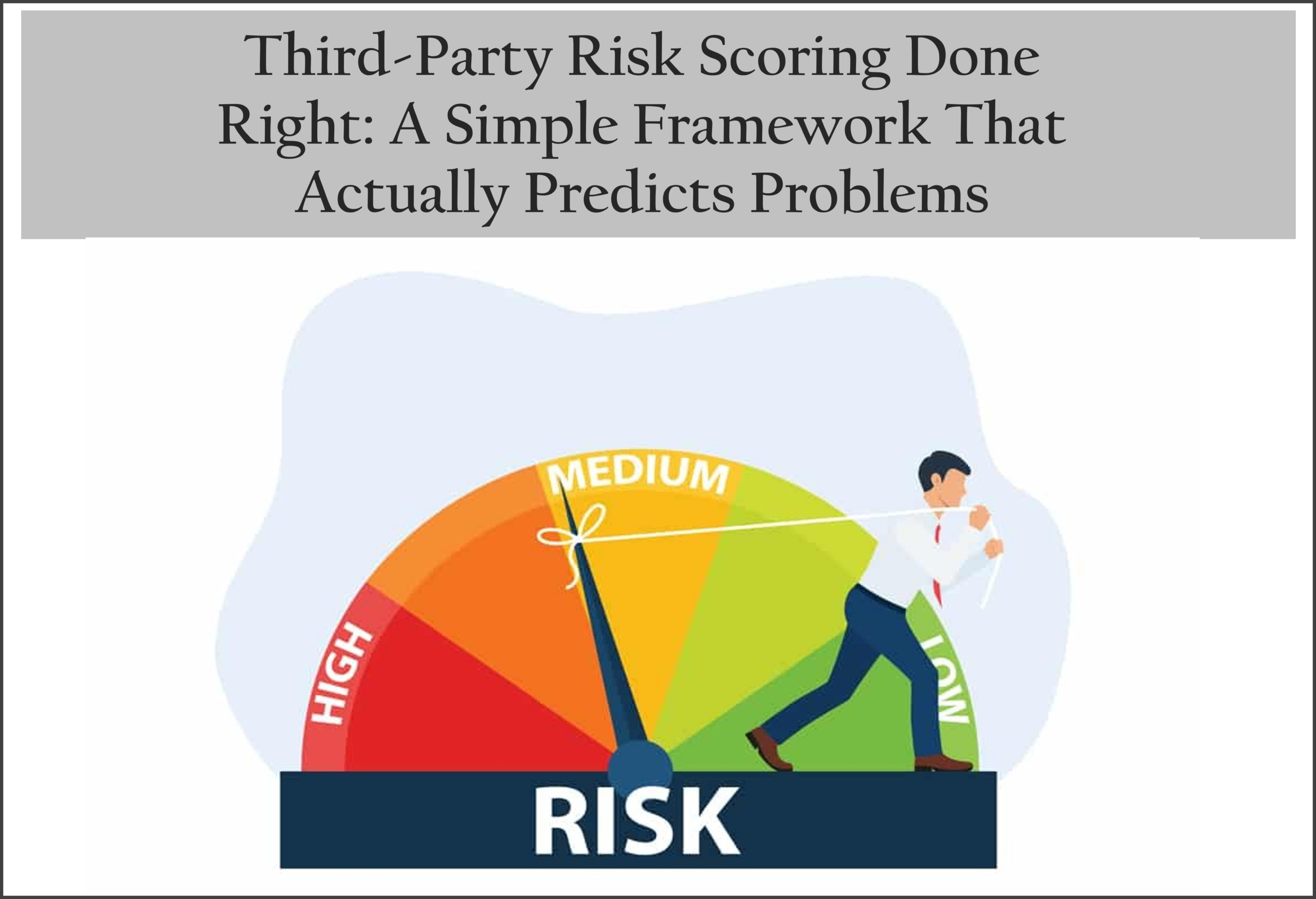
Third-Party Risk Scoring Done Right: A Simple Framework That Actually Predicts Problems
Most companies score their vendors. Few do it in a way that actually helps them spot trouble before it hits.
You send out questionnaires, review SOC 2 reports, check financials, and assign a color: green, yellow, or red. Then the vendor gets onboarded. Six months later, a breach at that “low-risk” vendor exposes your customer data, triggers a regulatory investigation, or causes a major operational disruption.
Sound familiar?
The problem isn’t that companies skip scoring. It’s that many scoring approaches are too simplistic, inconsistent, or static. They fail to combine Inherent risk (all the things that could occur before adding any controls) with Residual risk (what’s left after controls). They ignore business context. And they treat scoring as a one-time event instead of a living process.
At Ward Tech Audit & Compliance, we help organizations build and refine practical third-party risk scoring frameworks that drive better decisions. Here’s some straightforward, effective things you can do—plus common pitfalls to avoid—so your scoring actually predicts and prevents problems.
Why Most Vendor Risk Scoring Falls Short
Common weaknesses we see:
> Over-reliance on a single factor (e.g., just a security rating or questionnaire score)
> No distinction between inherent and residual risk
> Inconsistent criteria across departments or vendor types
> Static scores that don’t reflect changes over time
> Scores that feel arbitrary and lack clear ties to business impact
The result? High-risk vendors slip through, or your team wastes time over-assessing low-risk ones. In 2026, with increasing regulatory scrutiny and sophisticated supply-chain attacks, this approach is no longer sufficient.
A Practical Third-Party Risk Scoring Framework
Use these 5 simple, yet robust steps when risk scoring your third-party vendors. They combine quantitative scoring with business context for more accurate, defensible results.
1. Calculate Inherent Risk (The Risk Before Controls) –
Inherent risk reflects the vendor’s potential impact based on what they do for you—independent of their own security program.
Some key factors to score (on a 1-5 or 1-10 scale):
> Data sensitivity & volume— Does the vendor access PII, PHI, financial data, or intellectual property?
> Operational criticality— Would a failure disrupt core business processes, revenue, or customer experience?
> Access level— Do they have direct system integration, administrative privileges, or physical access?
> Regulatory exposure— Does the relationship bring SOX, HIPAA, PCI, GDPR, or CMMC requirements?
> Fourth-party / concentration risk— How many of your critical services flow through this vendor or their subservice organizations?
💡Tip: Multiply or weight these factors (e.g., using a likelihood × impact matrix) to produce an inherent risk score. High inherent risk vendors automatically require deeper due diligence.
2. Assess Control Effectiveness (The Residual Risk Adjustment) –
Now layer in evidence of how well the vendor mitigates that inherent risk.
Sources of evidence:
> SOC 2, ISO 27001, or other audit reports (with careful review for red flags)
> Completed security questionnaires (SIG, CAIQ, or custom)
> Security ratings from tools like Bitsight or SecurityScorecard
> References, incident history, and financial stability checks
> Your own testing or on-site reviews for critical vendors
Score the strength and maturity of controls in key areas: Logical access, change management, incident response, vendor (sub-processor) oversight, and ongoing monitoring.
Critical additional layer: Conduct targeted vendor background and ownership research.
This step often reveals risks that SOC 2 reports and questionnaires miss—especially in today’s SaaS-heavy market where many vendors are backed by private equity (PE) or have undergone rapid funding and M&A activity.
Key research areas to investigate (using free or low-cost public sources such as Crunchbase, PitchBook summaries, news archives, Dun & Bradstreet, and breach databases):
> Ownership structure — Is the vendor owned or majority-controlled by a private equity firm? PE-backed vendors can face pressure for aggressive cost-cutting during the hold period to prepare for an exit, which frequently weakens cybersecurity controls, reduces security staffing, or delays critical patching and monitoring. Recent industry reports show cyber incidents increasing during PE hold periods, with average financial impacts around $2.1 million per event.
> Investment history — Have there been multiple funding rounds involving several PE firms? Heavy investment activity often signals a focus on rapid growth at the expense of operational maturity—or an impending sale that could disrupt service quality, data handling, and control environments.
> M&A and competitor activity— Has the vendor (or its direct competitors) been recently acquired, or are similar solutions in the same space being consolidated? This can introduce hidden risks like data migration issues, shifting product priorities, integration gaps, or expanded attack surfaces that affect security and availability.
> Financial health— Check for signs of distress such as declining revenue, high debt levels, or cash-flow issues. These increase the chance the vendor will cut corners on security investments or even face bankruptcy.
> Reputation and breach history— Search news archives, breach databases (e.g., Have I Been Pwned summaries or regulatory filings), and customer complaints for past incidents or litigation. Even “resolved” breaches can indicate deeper cultural or control weaknesses.
How this research adjusts your score:
If the research uncovers PE ownership with signals of cost reductions, multiple rapid funding rounds, recent competitor acquisitions, or prior incidents, increase the Residual risk—even if the SOC 2 looks clean. These factors often predict future control degradation that static audits can’t catch. For example, add points (or adjust the weighting) to reflect heightened likelihood of operational or security lapses.
Subtract (or adjust downward) from the inherent risk based on overall control quality plus this background research. The remaining score is your Residual risk—the real risk your organization still carries.
3. Apply Vendor Tiering – Translate scores into actionable tiers:
> Tier 1 (Critical/High Risk) — High inherent + higher residual risk. Requires full annual assessment, continuous monitoring, and executive review.
> Tier 2 (Moderate) — Balanced risk. Standard periodic reviews and targeted monitoring.
> Tier 3 (Low)— Minimal inherent risk with strong controls. Lightweight annual attestations suffice.
Tiering lets you allocate resources intelligently, focusing effort where it matters most.
4. Add Trend & Trajectory Monitoring –
The best frameworks aren’t static. Track how a vendor’s score changes over time:
> Is their residual risk improving or worsening?
> Are exceptions in SOC 2 reports repeating?
> Has their security rating declined?
> Have there been ownership changes, new funding rounds, M&A activity, or shifts in financial health?
A vendor whose score is trending downward—or whose ownership/funding picture has shifted dramatically—deserves immediate attention, even if the absolute number still looks acceptable.
5 Quick Wins to Make Your Scoring More Predictive –
Quick Wins:
1. Document your methodology— Define scoring criteria, weights, and thresholds in a policy. This ensures consistency and helps during audits.
2. Incorporate business context— A generic security score means little without understanding how the vendor fits into *your* operations—and without the ownership/financial background check.
3. Set clear acceptance thresholds— Example: No Tier 1 vendor with residual risk above “moderate” gets approved without mitigation or executive sign-off.
4. Automate where possible— Use tools to pull security ratings, questionnaire data, and basic ownership/funding info, but always apply human judgment for interpretation.
5. Review and refresh annually (or upon material change) — Contracts, services, ownership, or threat landscapes evolve. So should your scores.
Common Pitfalls That Undermine Even Good Frameworks:
> Treating a clean SOC 2 as a “get out of jail free” card (see our post on SOC 2 red flags).
> Skipping ownership, PE involvement, and financial research—especially for SaaS vendors where cost pressures or M&A activity can erode controls quickly.
> Ignoring fourth-party risk hidden in the vendor’s supply chain.
> Scoring based only on self-reported data without independent validation.
> Failing to close the loop—scores exist but don’t influence contracting, monitoring frequency, or termination decisions.
Build a Scoring Process That Drives Real Protection:
A strong third-party risk scoring framework doesn’t eliminate risk—it makes it visible, measurable, and manageable. It helps leadership understand exposure in business terms and gives audit, compliance, and procurement teams clear guidance.
When done right, it becomes a competitive advantage: faster vendor onboarding for low-risk partners, stronger negotiations with high-risk ones, and fewer surprises during your next audit or incident.
At Ward Tech Audit & Compliance, we specialize in helping mid-sized organizations design, implement, and mature their third-party risk scoring and vendor oversight programs. Whether you need help building a custom framework from scratch, reviewing your current scoring model for gaps, or independently assessing high-risk vendors (including deep SOC 2 analysis and ownership/financial research), our practical approach delivers clear, actionable insights tailored to your risk appetite and regulatory environment.
Ready to move beyond basic checklists to scoring that actually predicts problems?
Contact Ward Tech Audit & Compliance for a no-obligation discussion on strengthening your third-party risk management program.
PDF Version: