

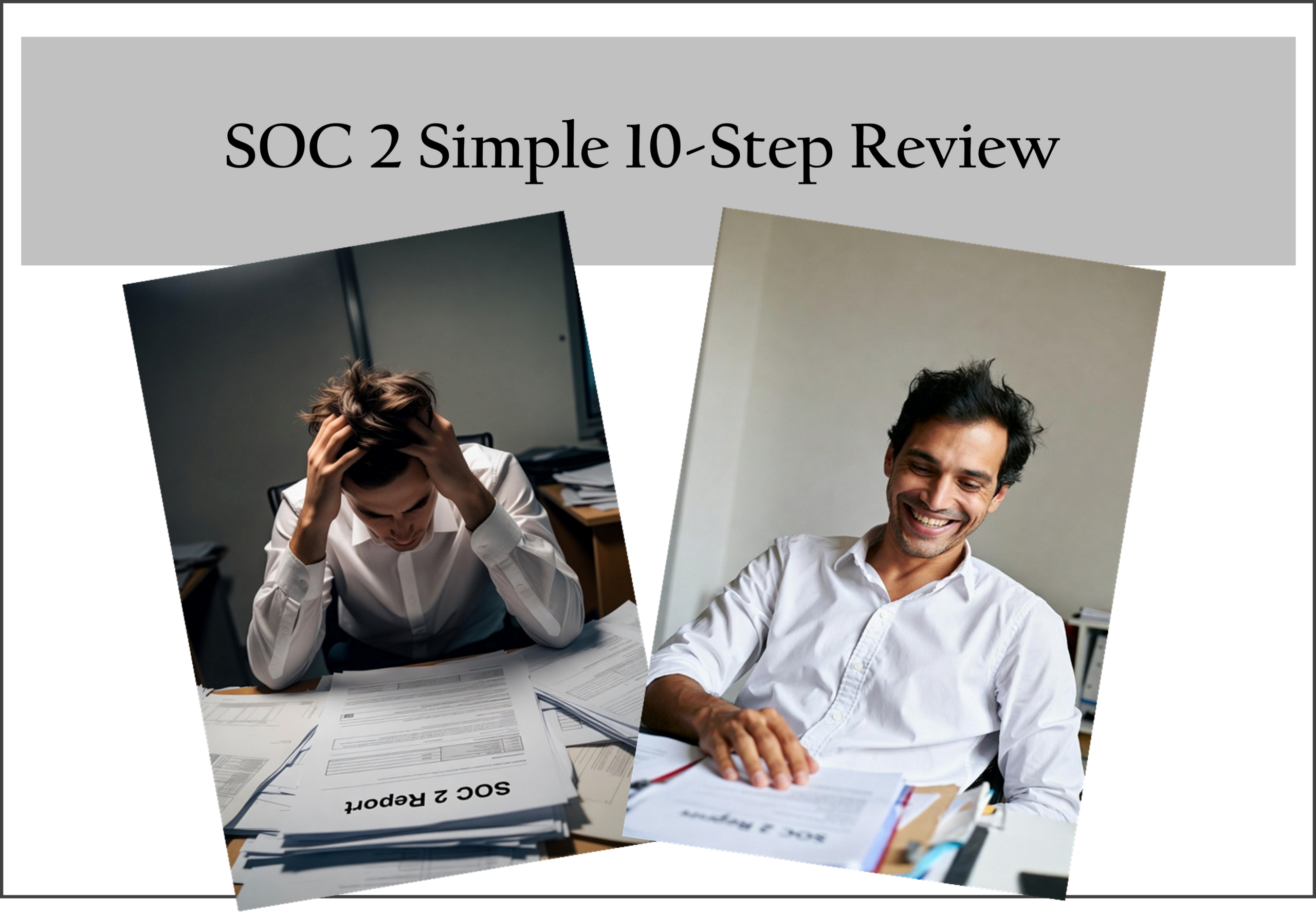
SOC 2 Simple 10-Step Review
If you work with vendors that handle sensitive data, reviewing a SOC 2 report isn’t just a formality—it’s essential for protecting your organization. But let’s be honest: these reports can feel dense and overwhelming.
So what exactly is a SOC 2 (Type II) report?
In simple terms, it’s an independent audit report that shows how well a company (i.e. Your vendor!) protects data over a period of time (typically 3–12 months). It doesn’t just confirm that controls exist—it proves those controls were consistently working during the review period.
The good news? You don’t need to be an auditor to review one effectively.
Here’s a simple, practical 10-step guide to help you confidently evaluate any SOC 2 report. An Infographic is also included at the end which can be used for training or even to as a reminder of what to review.
1. 📅REPORTING PERIOD – Ensure the Reporting Period is Current
Start by confirming the reporting period is current and complete.
- Are there any gaps in coverage?
- If so, is there a bridge letter explaining what happened in between?
A clean, continuous reporting period ensures you’re not missing potential risk windows.
2. 🏢REPUTABLE FIRM – Verify the Audit Firm and Their Reputation
Not all audit firms carry the same weight.
Ask yourself:
- Is the firm reputable?
- Do they have relevant certifications and experience?
- Are they recognized in the industry?
A strong auditor adds credibility to the report.
3. ✅RELIANCE – Review the Auditor’s Opinion (Reliance Conclusion)
This is one of the most important sections in the report.
Look for the type of opinion issued:
- Unqualified (Clean): Controls are well-designed and operating effectively ✅
- Qualified: Some issues were identified ⚠️
- Adverse: Significant control failures ❌
- Disclaimer: Auditor couldn’t form an opinion 🚫
A clean opinion means you can generally place high reliance on the controls.
4. 🎯SCOPE – Confirm the Scope includes Your Services
Make sure the services you actually use are included in the report.
If they’re not in scope, the report doesn’t provide assurance for those services—which could leave a blind spot.
5. 🔍SCAN – Scan for Exceptions and Control Weaknesses
Don’t skip the details—Scan for:
- Control exceptions
- Deviations
- Weaknesses
Even a report with a clean opinion can include minor issues worth understanding.
6. 🛡️CONTROL ENVIRONMENT – Review Control Environment for Management’s Commitment to Doing Things Right
This section reflects management’s “tone at the top.”
Look for:
- Commitment to security and compliance
- Clear policies and accountability
- Oversight and governance practices
A strong control environment usually signals a mature and trustworthy organization.
7. 🧩CARVED OUT – Check for Carved-Out Subservice Organizations and Review Their SOC Reports
Sometimes vendors rely on third parties (e.g., cloud providers), and these may be carved out of the report.
If so:
- Identify those subservice providers
- Obtain their SOC reports separately
You need full visibility across the entire service chain.
8. ⚙️CUECS – Understand Your Responsibilities and Verify they are Effectively Performed
Complementary User Entity Controls (CUECs) are controls you, the customer, must implement.
Examples might include:
- Managing user access
- Configuring security settings
Make sure:
- You understand these responsibilities
- Your organization is actually performing them
Even the best SOC 2 report won’t protect you if you’re not doing your part.
9. 🔐TSC – Review Trust Services Criteria (TSC)
SOC 2 reports are based on the Trust Services Criteria defined by the AICPA.
These include:
- Security (mandatory)
- Availability
- Processing Integrity
- Confidentiality
- Privacy
Review how controls align with these areas to assess whether the system is secure, reliable, and compliant.
10. 📈TRENDS – Look for Trends Over Time
Don’t just review one report—Compare across years.
Watch for:
- Repeated exceptions (e.g., access control issues)
- Recurring weaknesses
- Improvements or deteriorations
💡 Pro tip: Keep a record of SOC review results each year using a template or common format in a spreadsheet or database). It makes future reviews faster and helps you spot patterns easily.
Final Thoughts
A SOC 2 report doesn’t have to be intimidating. By following these 10 steps, you can quickly cut through the noise and focus on what really matters—Risk, Controls, and Trust.
SOC 2 Simple Review Summary — The 10-Steps:
- 📅REPORTING PERIOD
- 🏢REPUTABLE FIRM
- ✅RELIANCE
- 🎯SCOPE
- 🔍SCAN
- 🛡️CONTROL ENVIRONMENT
- 🧩CARVED OUT
- ⚙️CUECS
- 🔐TRUST SERVICES CRITERIA (TSC)
- 📈TRENDS
With a structured approach, you’ll not only review reports more efficiently but also make better, more informed decisions about the vendors you rely on.
💡 Pro tip: Don’t stop at identifying issues—Have a clear process for what happens next. If you uncover high-risk concerns, define steps such as documenting the issue and who needs to be involved including who is Responsible and Accountable (and who needs to be Consulted and Informed), requesting remediation details from the vendor, evaluating compensating controls, and determining whether to accept, mitigate, or escalate the risk. Having a consistent response plan ensures issues are addressed proactively rather than overlooked.
INFOGRAPHIC – 10 Steps to an Easy SOC 2 Review

PDF Version: